
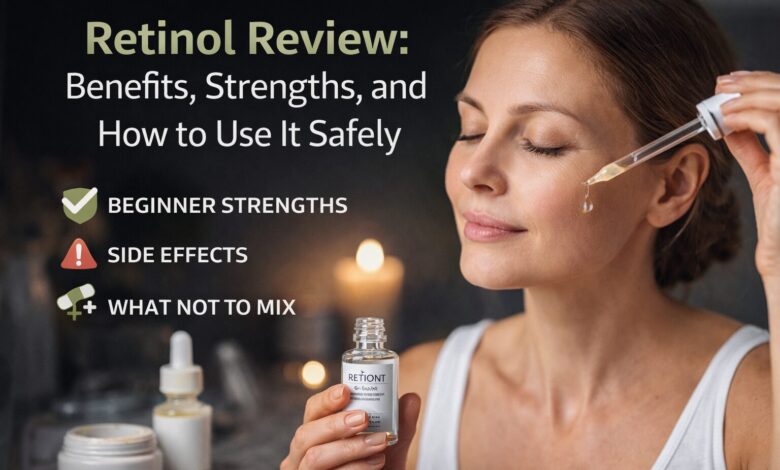
Retinol remains one of the most researched and widely recommended skincare ingredients. In this complete retinol review, we break down retinol benefits, ideal strengths for beginners, potential side effects, and how to use retinol safely for long-term results.
If you are considering adding retinol to your routine, this guide will help you avoid common mistakes and choose the right formula.
Quick Verdict
Overall Rating: 4.5/5
Best For: Texture, fine lines, acne-prone skin
Beginner Friendly: Yes (with slow introduction)
Patience Required: Absolutely
This retinol review confirms that consistency and correct usage determine success more than strength alone.
What Is Retinol?
Retinol is a vitamin A derivative belonging to the retinoid family. Once applied, it converts into retinoic acid inside the skin, which helps regulate cell turnover and collagen production.
Compared in the common retinol vs tretinoin debate:
-
Retinol = over-the-counter, slower conversion, milder
-
Tretinoin = prescription-strength, direct active form
Retinol is generally better suited for beginners.
Retinol Benefits: What Results Can You Expect?
1. Improved Skin Texture
Retinol accelerates skin renewal, helping rough areas feel smoother.
2. Reduced Fine Lines
It stimulates collagen production over time.
3. Fewer Clogged Pores
One reason retinol for beginners with acne-prone skin is often recommended.
4. Brighter Tone
By encouraging turnover, it can improve dullness and post-acne marks.
What It Cannot Do
-
Deliver overnight results
-
Replace sunscreen
-
Permanently “shrink” pores
-
Eliminate deep wrinkles instantly
Most visible improvements appear after 8–12 weeks.
Retinol for Beginners: Safe Starting Plan
In this retinol review, the most important advice is: start low and slow.
Suggested Beginner Schedule
Weeks 1–2: 1 night per week
Weeks 3–4: 2 nights per week
Week 5+: Increase gradually if no irritation
Use a pea-sized amount on dry skin only.
Follow with moisturizer to minimize retinol side effects.
How to Use Retinol Properly
Night Use Only
Step-by-Step
-
Gentle cleanser
-
Wait until skin is fully dry
-
Apply pea-sized retinol
-
Apply moisturizer
If sensitive, use the sandwich method:
Moisturizer → Retinol → Moisturizer
Always apply broad-spectrum SPF in the morning.
Retinol Side Effects
Common retinol side effects include:
-
Dryness
-
Peeling
-
Redness
-
Temporary sensitivity
Retinol Purge
A short-term breakout phase may happen, especially in acne-prone skin. The retinol purge usually lasts 2–6 weeks.
If irritation is severe, reduce frequency.
What Not to Mix With Retinol
Avoid strong exfoliants (AHA/BHA) on the same night when starting.
Safer split routine:
-
Retinol nights
-
Exfoliation nights
Vitamin C is often better used in the morning if irritation occurs.
Comparison Section: Best 3 Retinol Products
1. La Roche-Posay Retinol B3 Serum
Best For: Sensitive beginners
Strength: Moderate
Why It Stands Out: Contains soothing niacinamide
Pros:
-
Gentle formula
-
Good for first-time users
-
Dermatologist-tested
Cons:
-
Slower visible results
2. The Ordinary Retinol 0.5% in Squalane
Best For: Budget-conscious users
Strength: 0.5%
Why It Stands Out: Affordable and transparent concentration
Pros:
-
Clear percentage labeling
-
Good intermediate option
Cons:
-
Can feel oily
-
Minimal soothing ingredients
3. Olay Regenerist Retinol 24 Night Moisturizer
Best For: Dry skin
Strength: Gentle-moderate blend
Why It Stands Out: Combines retinol with hydration
Pros:
-
Hydrating base
-
Good for anti-aging beginners
Cons:
-
Concentration not fully disclosed
Retinol vs Tretinoin: Which Should You Choose?
If you want gradual improvement and lower irritation risk, retinol is usually the better first step.
If you need faster clinical results and can tolerate irritation, prescription tretinoin may be stronger.
For most readers of this retinol review, starting with retinol makes sense.
How to Choose the Right Retinol Formula
Look for:
✔ Stated concentration
✔ Fragrance-free if sensitive
✔ Support ingredients (ceramides, glycerin, niacinamide)
✔ Opaque packaging
Avoid:
✘ Alcohol-heavy formulas
✘ Unclear “retinol complex” labeling
✘ Open jars exposed to air
References
-
American Academy of Dermatology – Retinoids: What They Are and How They Work
https://www.aad.org/public/everyday-care/skin-care-basics/dry/retinoids -
National Institutes of Health – Vitamin A and Skin Health (Office of Dietary Supplements)
https://ods.od.nih.gov/factsheets/VitaminA-Consumer/ -
National Center for Biotechnology Information – Topical Retinoids Review (PubMed Central)
https://www.ncbi.nlm.nih.gov/pmc/articles/PMC2699641/ -
Mayo Clinic – Retinoids and Skin Care Overview
https://www.mayoclinic.org/drugs-supplements-retinol/art-20362217