
Quick Verdict (Review Summary)
Overall rating: ⭐⭐⭐⭐☆ (3.5/5)
Best for
-
Hydration support
-
Gentle anti-aging routines
-
Sensitive skin
Not ideal for
-
People expecting retinol-level wrinkle reduction
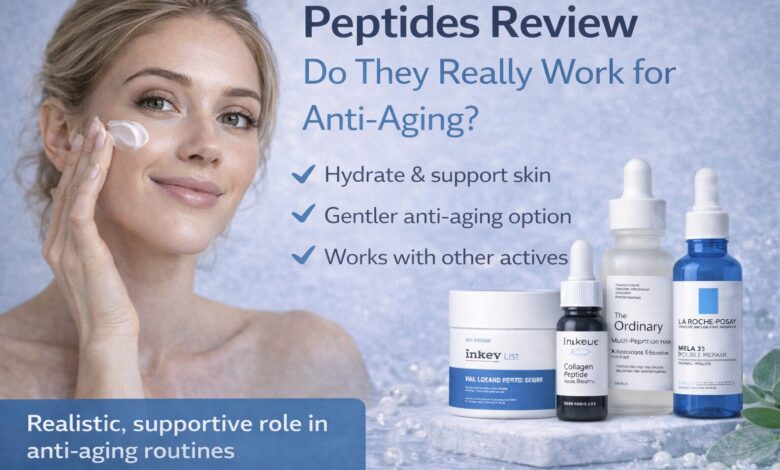
Peptides are a helpful supportive ingredient, but they should not replace proven skincare pillars like sunscreen and retinoids.
What Are Peptides? (Simple Explanation)
Peptides are short chains of amino acids, the building blocks of proteins such as collagen and elastin in the skin.
In skincare products, peptide serums are commonly used to:
-
Support smoother-looking skin
-
Improve hydration
-
Complement anti-aging routines
However, expectations should remain realistic. Peptides support the skin, but they usually do not produce dramatic wrinkle reduction on their own.
Benefits: What Peptides Can and Can’t Do
What peptides can help with
-
Improve hydration and skin softness
-
Support smoother skin appearance
-
Complement anti-aging routines
What peptides cannot do
-
Reverse deep wrinkles dramatically
-
Replace retinoids or sunscreen
Results vary depending on the peptide type, concentration, and formula quality.
Who Should Use Peptides?
Peptide products work best for:
-
Sensitive skin that cannot tolerate strong actives
-
People building a gentle anti-aging routine
-
Anyone looking for a supportive hydrating serum
They are especially helpful for users who want a low-irritation skincare ingredient.
How to Use Peptides (AM / PM Routine)
Peptides are flexible and easy to integrate into most skincare routines.
Morning routine
Cleanser → Peptide serum → Moisturizer → Sunscreen
Evening routine
Cleanser → Peptide serum → Moisturizer
For best results, use peptides daily, as improvements are gradual.
What Not to Mix (Or How to Use Safely)
Peptides are generally compatible with most ingredients.
However, if your routine includes strong actives:
-
Use vitamin C in the morning
-
Use retinol at night
-
Peptides can be used on non-retinol nights or in the morning routine
If irritation occurs, simplify the routine.
Possible Side Effects
Peptides themselves rarely cause irritation.
Most reactions are caused by:
-
Fragrance
-
Preservatives
-
Heavy formulas
To reduce risk:
-
Choose fragrance-free formulas
-
Patch test new products
How to Choose a Good Peptide Product
When shopping for peptide serums, look for:
✔ Peptides listed high in the ingredient list
✔ Hydrating ingredients like glycerin or hyaluronic acid
✔ Fragrance-free formulas if your skin is sensitive
Avoid:
-
Products marketed as “miracle wrinkle cures”
-
Extremely overpriced peptide formulas with weak ingredient lists
Simple Starter Routine
Morning
Cleanser → Peptide serum → Moisturizer → SPF
Evening
Cleanser → Peptide serum → Moisturizer
If you use retinol, peptides work well on recovery nights.
Related Guides (Internal Links)
To improve your skincare routine, read:
-
Retinol guide:
https://bioverra.com/retinol-review/ -
Ceramides barrier repair guide:
https://bioverra.com/ceramides-review/ -
Hyaluronic acid hydration guide:
https://bioverra.com/hyaluronic-acid-review/
Practical Tips
✔ Use peptides as supportive ingredients, not miracle treatments
✔ Combine them with sunscreen and retinoids for stronger anti-aging routines
✔ Track results over 8–12 weeks, not a few days
Consistency matters more than strength.
FAQ
Do peptides really work for wrinkles?
Peptides may improve the appearance of fine lines mainly through hydration and supportive effects, but results are typically modest.
Are peptides better than retinol?
No. Retinoids have stronger scientific evidence for anti-aging benefits. Peptides are a gentler supportive ingredient.
Can peptides be used with vitamin C?
Yes. Many routines use vitamin C in the morning and peptides either in the morning or evening.
How long until peptides show results?
Hydration effects can appear quickly, while smoother-looking skin may take several weeks.
Who should use peptide serums?
They are ideal for people looking for a gentle anti-aging step, especially those with sensitive skin.
Sources
-
American Academy of Dermatology – Peptides in skincare
https://www.aad.org/public/everyday-care/skin-care-basics/care/peptides-skin-care -
Harvard Health Publishing – Understanding skin aging and skincare ingredients
https://www.health.harvard.edu/staying-healthy/skin-care-basics -
National Library of Medicine – Peptides and skin aging research
https://pubmed.ncbi.nlm.nih.gov/23884792/